
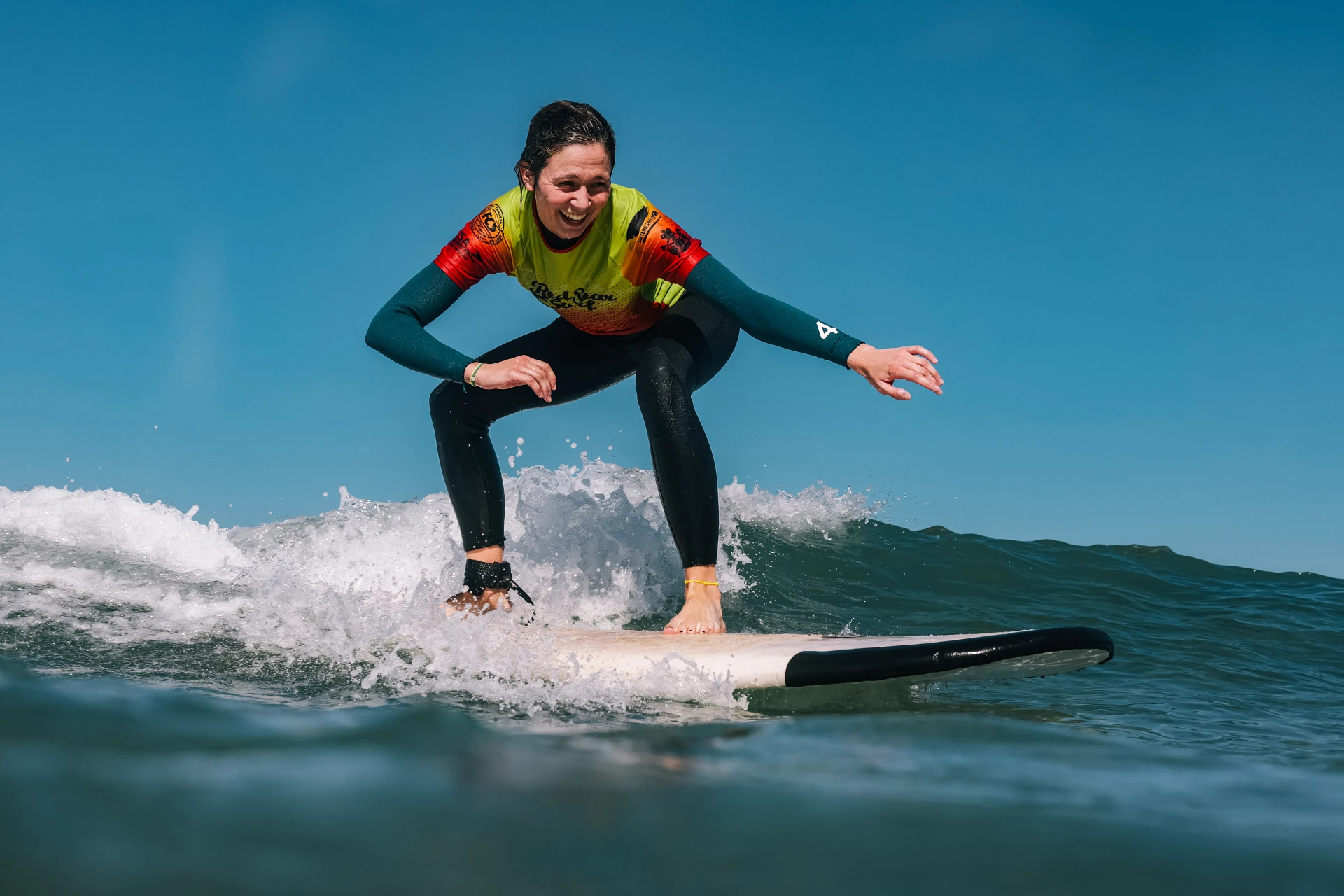
Updated

Every surfer remembers the first time they stood up. Not the first wave they caught lying down, not the first time the foam pushed them to the beach — the first time they got to their feet and the board kept going. That moment is the take-off, also called the pop-up, and it is the single most important movement in surfing. Get it right early and everything after it comes faster. Here is how we teach it in Famara, step by step, and the mistakes we see every single day on the beach.
What the take-off actually is
The take-off is the transition from lying on the board and paddling to standing on it with the wave already pushing you. It has to be fast — one to two seconds — and it has to land you in the right place on the board, with your weight centred and your eyes looking down the line. Everything you do later, from turning to riding a green wave, depends on where your feet end up in those two seconds.
The good news: it is a movement, not a talent. People who do yoga, skateboard or climb usually pick it up in a session or two because they already know where their body is in space. Everyone else picks it up with repetition. That is why we start every beginner lesson on the sand, doing the movement dry, before anyone gets wet.
Regular or goofy: which foot goes forward?
Before you can pop up you need to know your stance. Regular means you stand with your left foot forward; goofy means your right foot forward. Neither is better, it is just how your body is wired. If you don’t know yours yet, there are three ways to find out.
On the beach — the push test
This is what we do on the first day. Stand relaxed with your feet together and eyes closed; the instructor gives you a small, unexpected push from behind. The foot you step forward with to catch yourself is your front foot on the board. It works because the reflex is faster than thinking.
Anywhere — the heavy object
Imagine pushing a stalled car. Which foot do you plant behind you for power, and which goes forward? Front foot forward is your surf stance. Again, don’t think about it; let the first instinct decide.
Snowboard or skateboard
If you already ride a board on snow or concrete, start with the same stance. It is right most of the time, but not always: surfing loads the legs very differently, and we regularly see riders who switch after they learn to surf. Treat it as a starting point, not a rule.

Lying in the right place on the board
Most failed take-offs are lost before the wave arrives, because the surfer is lying in the wrong spot. The rule is simple: the centre of your body weight — for most people, the belly button area — sits over the centre of the board’s volume. Not its geometric middle: a board with a wide nose and narrow tail has its volume further forward, a pointed shortboard further back.
Too far forward and the nose dips and buries as the wave lifts the tail — the classic “pearling” wipeout. Too far back and you paddle uphill, the tail drags and the wave rolls under you without taking you. On your board, find the spot where the nose sits two or three centimetres above the water while you paddle, and remember where your chin is relative to the board.
Timing: the two extra strokes
Paddle towards the beach and look over your shoulder at the wave coming. If you don’t look back it will surprise you, and the take-off turns into a scramble for balance. The moment to stand is when you feel the wave take the board — the tail lifts, the board accelerates and you start to slide down the face.
The most common beginner mistake is to stop paddling too early. The first push of whitewater feels like you have caught the wave, but you haven’t yet; stand up now and the wave passes underneath and leaves you sitting in the flat. Our instructors say the same thing all day: two more strokes. When you think you have it, paddle twice more, then go.
The take-off in three steps
1. Hands on the board
Place your open palms flat on the deck at rib level, elbows tucked in against your body. Do not grab the rails. Holding the edges moves the load from your chest and shoulders into your triceps, which are much weaker, and it narrows your base — both make you wobble. Palms flat, elbows in, chest up.
2. Back foot
Push your chest up and bring the back foot forward onto the deck, roughly above the fins. The foot should land flat and across the board, not along it, so that it is already in its final position. If the back foot lands pointing forward you will have to shuffle it later, and the shuffle is where people fall.
3. Front foot
This is the step that takes strength and needs the most practice. Straight after the back foot, push hard with your hands and swing the front foot through to land where your hands were — in the middle of the board, roughly under your chest. Land on the whole foot, knees bent, and let go of the board. You are standing.
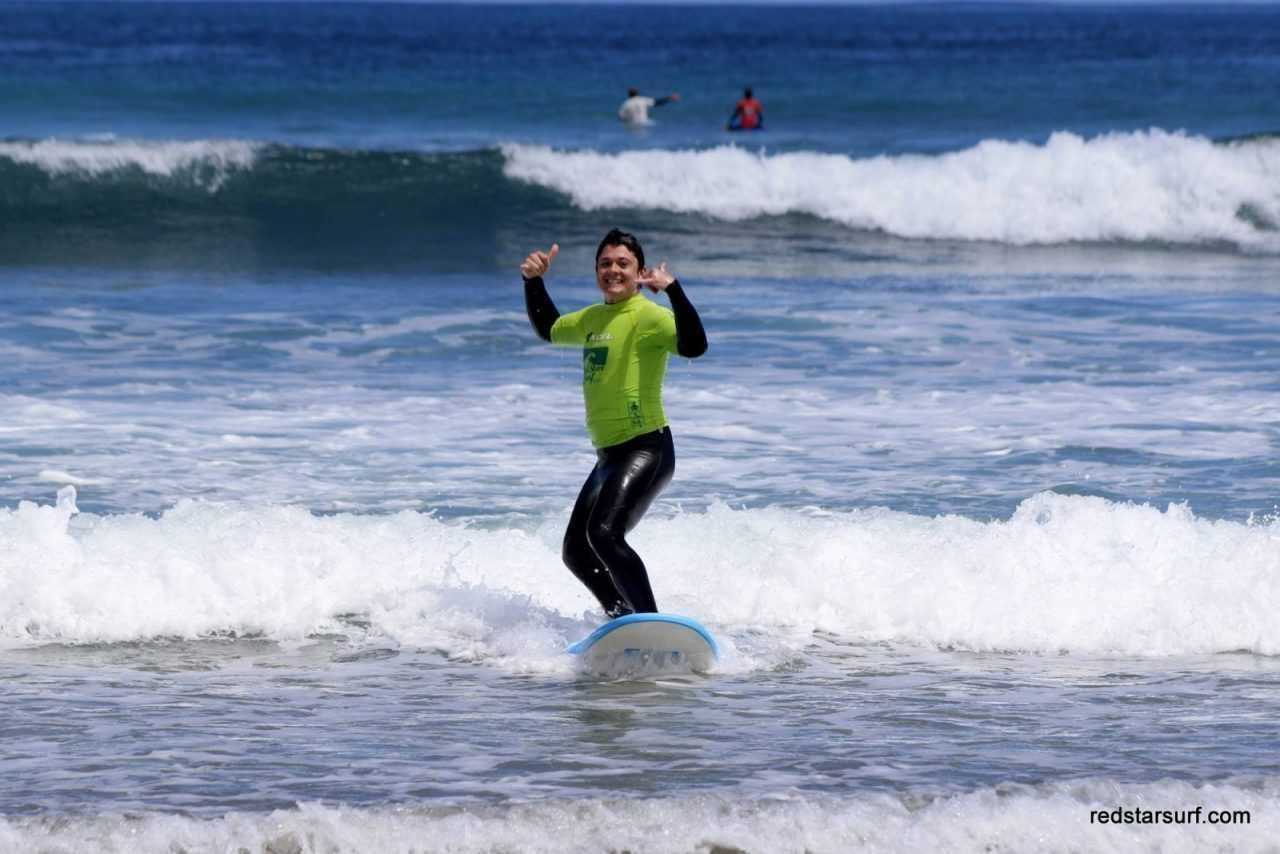
Some schools teach the “one-move” pop-up, where both feet land at once from a push-up. It is the fastest version and what most experienced surfers do, but it needs a lot of upper-body power and hip mobility. We teach back-foot-first because it works for everyone from day one, and it naturally evolves into the one-move version as you get stronger. Start with three steps, don’t skip to the shortcut.
The first three seconds standing
Getting up is half of it. Staying up depends on five things we repeat until they become reflexes:
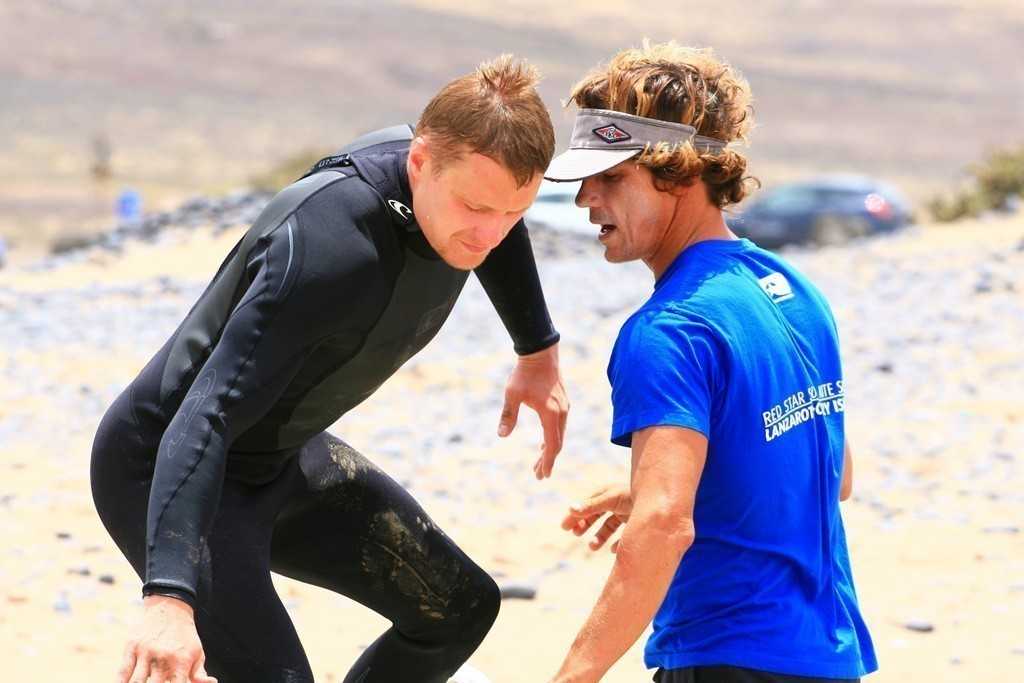
Eyes. Look where you want to go — down the line, along the wave, at the beach. Looking down at your feet is the number one cause of falling in the first second.
Knees. Always bent. Straight legs turn you into a lever; the first bump throws you off. Think of sitting slightly on a high stool.
Body. Your chest faces the same way your eyes look, and your weight sits evenly on both feet. Leaning back is the natural reaction when it feels fast, and it stalls the board and drops you off the back.
Arms. Relaxed and slightly open to the sides, roughly at hip height. They are your balance, not your steering wheel — no windmilling.
Back. Straight. When you bend at the waist you fall in the direction you are bending, almost every time.
And when it goes wrong: get low. Lowering your centre of gravity saves more rides than any other trick. If the fall is coming anyway, cover your head with your arms as you go in and come up slowly with a hand above you. In Famara the bottom is sand, but your own board is the thing that hits people.
How to practise at home
The take-off is one of the few surf skills you can train on land, and it makes a real difference. Draw a board outline on the floor with tape, mark the centre, and do ten pop-ups a day: lie down, palms at the ribs, back foot, front foot, freeze in the stance for three seconds. Check that the front foot lands on the mark every time. Push-ups help, burpees help more, and anything that opens the hips — yoga, in particular — makes the front-foot swing much easier. We wrote a whole guide to fitness for surfing if you want a plan.
Then come and do it on a wave. In Famara the beach break gives you long, soft foamies where you can try forty take-offs in a two-hour session, and an instructor on the beach telling you which of the five points above you just forgot. That feedback loop is why people stand up in their first lesson here. If you are choosing a board for after your course, the surfboard choice guide explains why a bigger board makes the take-off easier, not harder.
Take-off questions we hear every day
Why do I keep nose-diving when I try to stand up?
You are lying too far forward on the board, or standing up too late, after the wave has already tipped the board down the face. Shift back a few centimetres and go a fraction earlier, as soon as the tail lifts.
Why does the wave pass under me without taking me?
You stopped paddling too soon, or you are lying too far back. Two more strokes than you think you need, and check that the nose sits just above the water while you paddle.
Should I get up on my knees first?
No. Kneeling feels safer but it is a dead end: you have to stand up from the knees, which is slower and puts you in the wrong place. Learn the three-step take-off from the start, even if the first attempts are messy.
How long does it take to learn the take-off?
Most people stand up on whitewater in their first two-hour lesson. Doing it consistently, and then on green waves, takes a week of surfing for most beginners — which is exactly why a five-day course exists.


