
Red Star Surf • Caleta de Famara Most pages about kitesurfing in Famara will tell you it is a paradise. That is not wrong, but it is not useful either. What decides whether you get a session here is narrower than that: the wind has to come from roughly the right angle, and the tide has to be low enough to leave beach to work with. Get both and Famara is as good as it gets in Europe. Miss either and there is nothing to do but wait, and we would rather you heard that from us than found it out on a Tuesday. We teach and rent here every season, and we cancel more than half the kite lessons we schedule. Not because the forecast lies, but because conditions on this beach change faster than a forecast can follow. Everything below is what we look at before we say yes. The prevailing wind here is northwest, and for a beginner or an intermediate rider it is close to ideal. The reason is geometry rather than strength. The northerly component keeps you off the open ocean. If something goes wrong – a kite you cannot relaunch, a board you lost, a body–drag that is not working – the wind pushes you back towards the sand instead of out to sea. That single fact is the difference between an incident and an afternoon. The westerly component gives you side–shore to side–on, which is the angle you actually need to ride. It lets you travel along the beach and come back upwind, rather than only being blown in. Northwest gives you both at once: a safety net behind you and a usable line in front of you. Straight north is onshore: the wind points directly at the beach. How much that matters depends entirely on what stage you are at. For a first lesson it changes very little. The early work happens on the sand and in shallow water – flying the kite, learning the window, body–dragging – and an onshore wind is perfectly workable for that. If anything it is reassuring, because everything drifts back towards you. It starts to matter once you want to ride. To get out on the board and come back you need an angle across the beach. With the wind pointing straight in, you are pinned to the shore: you cannot make ground away from it, and every attempt finishes back on the sand a few metres downwind. Experienced riders work around it. Someone at the stage of their first water starts usually cannot, and that is when we call and move the session. A pure north day is not dangerous the way a strong offshore day is. It is simply the wrong day for a particular step, and which step you are on is what we look at before deciding. This is the part nobody writes about, and on this beach it matters as much as the wind. Famara is flat and shallow, so the water moves a long way horizontally. At low tide there are hundreds of metres of firm sand – room to lay out lines, walk a kite, teach someone to control it, launch and land without standing on top of the next group. At high tide that beach shrinks to a strip. What is left is narrow, busy and close to the shore break, and there is no safe space to do the ground work a first lesson is made of. So a day with perfect northwest wind at high water can still be a day we do not teach. Wind and tide have to line up in the same few hours. That is why our lesson times move around the clock instead of sitting at 10:00 like the surf ones, and why we confirm the exact hour the day before. Kitesurfing in Famara is only allowed in the kite zone, on the far part of the beach beyond the Famara Bungalows urbanisation. From the village up to the urbanisation, and in front of it, kiting is strictly forbidden. To get there, drive past the urbanisation and go down to the beach behind it – that back part of the beach is the kite zone. On lesson days we meet at the shop first for wetsuit and helmet and drive to the kite zone together; if your instructor is already on the water, you pick up your wetsuit at the shop and meet them in the kite zone at the agreed time. We run kite lessons all year, not only in summer, because the wind here does not read the calendar. That is the real number, and we would rather publish it than dress it up. Conditions turn unusable – the wind swings north, it dies, it comes in too strong, the tide fills the beach – and we cancel, because the alternative is putting a beginner on the water in a situation where nothing good can happen. It is also why we tell people not to book a kite lesson blind. Write to us first. We put you on the list, we watch the forecast and the tide table together, and when the two line up we call you and you come down. That sounds less convenient than a booking button, and in practice it wastes far less of your holiday. Message us on WhatsApp at +34 648 745 447 or write to info@redstarsurf.com with your dates, and we will tell you honestly what the week looks like. Because the two conditions are opposites, and that turns out to be the whole advantage of being here. No wind means better surf. A glassy, windless morning that kills a kite lesson is exactly the morning the waves are clean. And a howling day that flattens the surf is the day the kites go up. So when you book a Kite Camp package with accommodation, we say this before you pay, not after: if there is no usable wind during your stay, you surf instead. We are not a kite–only school, we do not need to pretend the wind will come, and the days that do not work for one sport almost always work for the other. Written into our terms: missed kite days inside a package are replaced by the same number of surf lessons, and we refund the price difference between a kite lesson and a surf lesson. A standalone kite lesson with no accommodation is different – we reschedule it first, and refund in full if we cannot. Surf, for the record, runs 365 days a year here, minus the two or three when it is unsafe or there is simply nothing. Super lessons with Juan who worked hard to get me on the water with the kite :) Great gear, well adapted to the changing conditions.Good coordination on the schedule based on tides + winds.Will come back for my next trip!From what I saw on the beach, I had the best instructor :) Un gusto las clases de surf con Mariano.Se adapta a cualquier nivel y es perfecto para coger una base sólida con la que poder practicar en cualquier lado. Además Famara es una playa perfecta tanto para el surf como para el kite. Lo recomendaría sin duda. I absolutely loved my stay in Lanzarote, and in particular the surfing lessons with Red Star! I took already a lot of classes around the world, and these were for sure the best ones I ever took. They recognized peoples' individual skills, and gave personal advise. They we're really the best teachers I've met. I originally booked kite lessons, but because of the weather that was only possible for one day. But they were very open and flexibele about it, so no worries.I would go back tomorrow if it was an option 😊 wir versuchten uns zum ersten Mal am Kiten. Trotz etwas böigem Wind und leichtem Wellengang gingen Simone und Javi super auf uns ein und lehrten uns mit viel Geduld und Motivation den Umgang mit dem Kite. Grazie mille und muchas gracias Estuvimos unos días allí para visitar la isla y aprender kite surf, ya que ni mi mujer no yo lo habíamos practicado nunca. A parte del lugar que es espectacular, el trato que nos dieron tanto el monitor como el encargado fue increíble. Sin duda que REPETIREMOS!! Northwest. The northerly component pushes you back towards the beach if anything goes wrong instead of out to open ocean, and the westerly component gives you the side-shore to side-on angle you need to actually ride along the beach. It is the direction that is both safe and usable, which is why it suits beginners and intermediates so well. It depends on your level. For a first lesson an onshore north wind changes little, because the early work happens on the sand and in the shallows and everything drifts back towards the beach. It matters once you want to ride: with the wind pointing straight in you cannot make ground away from the shore, and every attempt finishes back on the sand. Experienced riders work around it; someone at their first water starts usually cannot. A lot. At low tide there are hundreds of metres of firm sand to lay out lines, walk a kite and launch safely. At high tide the beach narrows to a strip next to the shore break and there is no room for ground work. Perfect wind at high water can still mean no lesson. May to September is the reliable stretch, when the trade winds are most constant. We teach all year, because wind here ignores the calendar – there have been windless summers and windy Januaries. Yes. More than half of the kite lessons we schedule get moved, because conditions turn unusable. That is why we ask people to contact us before booking rather than buying a slot blind. You surf instead. Inside a package with accommodation, missed kite days are replaced by the same number of surf lessons and we refund the price difference between a kite lesson and a surf lesson. A standalone kite lesson is rescheduled first and refunded in full if that is not possible. You can, but for kite we would rather you wrote to us first with your dates. We put you on the list, watch wind and tide together, and call you when they line up. It wastes far less of your week than a fixed slot that has to be cancelled. Kitesurf lessons · Kite rental · Lanzarote surf spot guide · Surf lessons · Frequently asked questions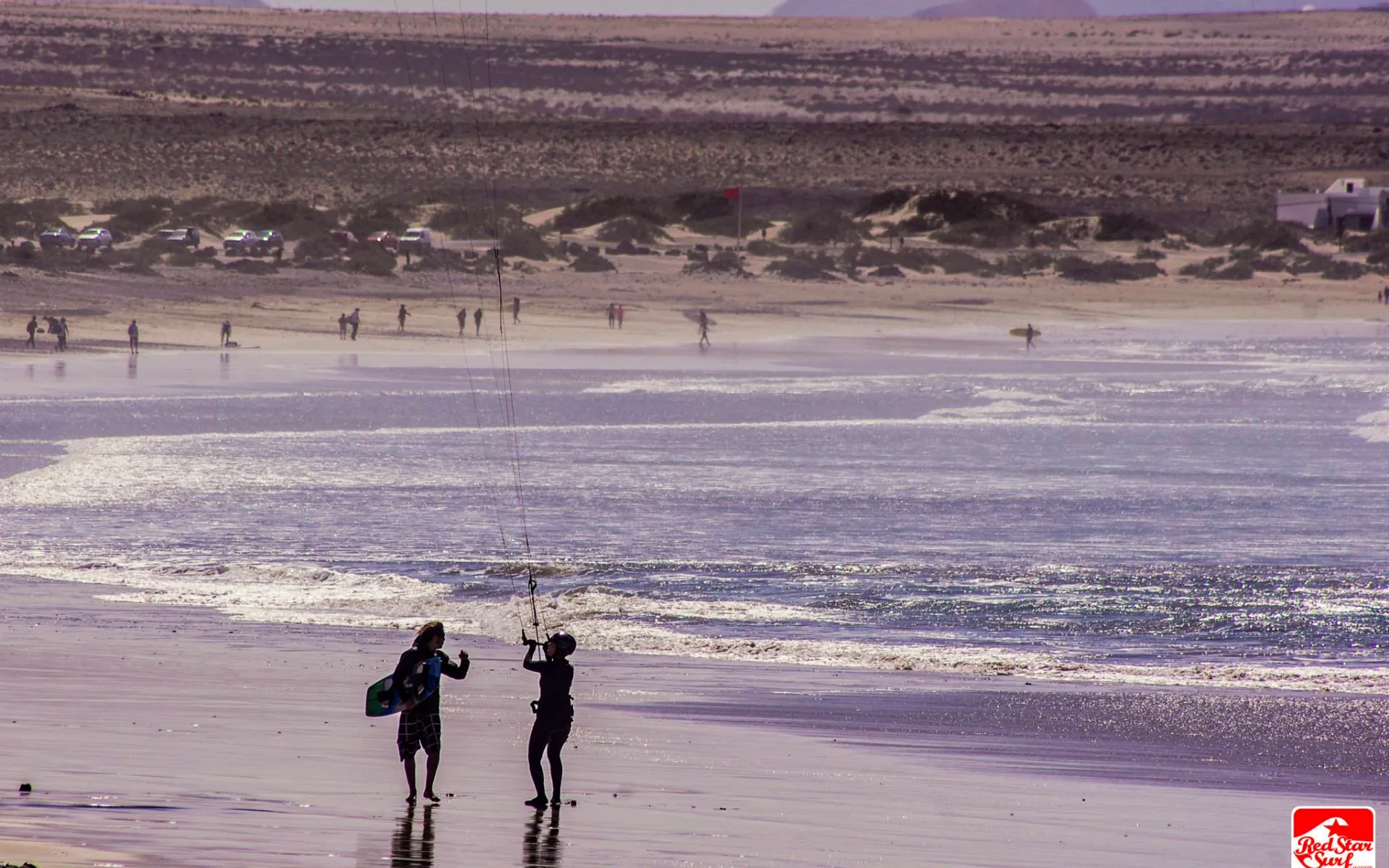
Kitesurfing in FamaraWind · Tide · What Actually Happens
Wind direction and tide decide almost everything here
Why northwest is the wind we want
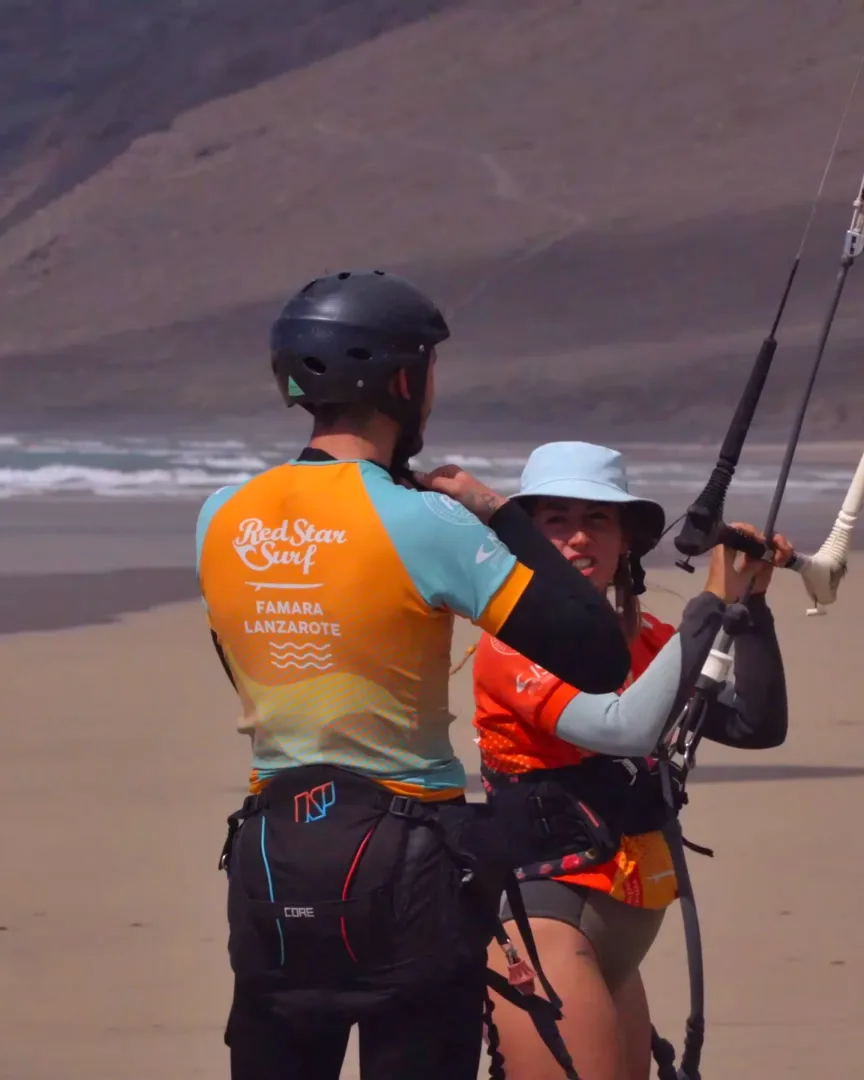 The setup happens on the sand. How much sand there is depends on the tide.
When the wind goes too far north – and for whom
The tide decides whether there is a beach at all
Where you can kite in Famara
Season, and what a season actually means
May to September
The trade winds are at their most reliable. If you are planning a trip around kite, plan it here.
October to April
Wind still comes, in bursts, and some of the best days of the year land in winter. It is simply less predictable, so it suits people who are already on the island rather than people flying in for a fixed week.
The honest version
We have had windless summers and windy Januaries. The season is a tendency, not a promise, and anyone who tells you otherwise is selling something.
More than half of our kite lessons move
Why we teach both surf and kite
Frequently asked questions
What is the best wind direction for kitesurfing in Famara?
Why is a north wind harder here, and for whom?
Does the tide matter for kitesurfing in Famara?
When is the kite season in Famara?
Do you cancel kite lessons often?
What happens if there is no wind during my Kite Camp?
Can I just book a kite lesson online?
Keep reading
Northwest is the wind we wantLow tide is the beach we need
★★★★★
★★★★★
★★★★★
★★★★★
★★★★★