

Updated
Nobody starts surfing for their health. You start because a wave picked you up once and you want that again. But after fifteen years of watching people arrive pale and tense on a Saturday and leave sunburnt, sore and grinning the next Saturday, we have a fairly good idea of what a week in the water does to a body and a head. Here is the honest version — what surfing really works, what it does for your mood and sleep, and the two or three things it can also hurt if you are careless.
What a surf session actually is
Forget the highlight reel. In a two-hour session an average surfer spends roughly half the time paddling, a third sitting or lying on the board reading the ocean, a few minutes duck-diving or pushing through whitewater, and — on a good day — three to five minutes standing on a wave. That mix is the point: it is a long, low-intensity endurance effort punctuated by short bursts of explosive strength (the pop-up, the sprint paddle for a wave) and constant small balance corrections. It adds up to something like 300–500 kcal an hour for most adults, which is comparable to a steady swim or a hard hike, and unlike either of those you do not notice the time passing.
| What surfing works | How | What you notice after a week |
|---|---|---|
| Shoulders, back, arms | hours of prone paddling | tighter posture, sore lats on day two, then not |
| Heart and lungs | sustained paddling + sprint efforts | climbing the stairs to the surf house gets easier |
| Core and hips | balance on the board, every pop-up | a stronger, steadier trunk; fewer wobbles |
| Legs | crouch and drive on the wave, duck-dives | quads and calves that know they have worked |
| Balance and proprioception | a moving platform under your feet | you stand up faster on day five than on day one |
| Mood and sleep | daylight, cold-ish water, effort, focus | you eat like a horse and sleep by ten |
1. Paddling: the cardio you did not sign up for
Paddling a surfboard is a prone swim with your shoulders, upper back and arms doing all the work and your core holding the rest of you still. It is the part beginners underestimate and the reason the second day hurts more than the first. It is also where most of the health benefit lives: long steady paddles out and back build cardiovascular endurance the way lap swimming does, and the short all-out efforts to catch a wave are interval training you never planned. If your shoulders are tight on Monday, that is normal; by Thursday they are usually stronger than they have been in years. We put together a fitness for surfing page for the weeks before you arrive — a little paddling-specific strength beforehand turns the first two days from survival into surfing.

2. Core, legs and balance: the pop-up is a burpee
Every wave you catch begins with a take-off: from lying down to standing in one movement, on a board that is accelerating down a slope. Done thirty times in a session it is thirty explosive push-ups with a jump attached, and it is why surfers have strong cores without ever doing a plank on purpose. Once you are up, the board never stops moving, so your ankles, knees, hips and trunk are making tiny corrections all the time — the kind of proprioceptive training physiotherapists use wobble boards for, except the wobble board is the Atlantic. The change is measurable inside a week: the same person who needed three attempts to stand on Monday stands first time on Friday, not because their technique changed but because their balance did.
3. Your head: why you feel so good afterwards
Ask anyone walking up the beach after a session how they feel and you get the same slightly stupid grin. There are a few things behind it. Two hours of physical effort outdoors releases the usual mix of endorphins and adrenaline; cold-ish water on the skin is a well-documented mood lifter in itself; and surfing demands a kind of attention — reading the swell, timing the paddle, committing to the wave — that leaves no room for the inbox. It is one of the few sports where you physically cannot check your phone.
Researchers have a name for the effect of time spent near, in and on the water: blue space, and the evidence that it lowers stress and improves mood is now solid enough that surf therapy programmes exist in several countries for people dealing with anxiety and burnout. We are not therapists, and a week in Famara is not treatment for anything. But we have seen a lot of people arrive wound tight and leave loose, and Andrey, our general manager, wrote about the other side of the coin — why surfing swings between happiness and frustration — because the highs make more sense once you understand the lows.

4. Sleep
This one nobody warns you about. Surfers on their first camp week sleep like children: in bed by ten, up at eight, no alarm needed. The reasons are not mysterious — two hours of real exertion, a full day of natural light which resets your body clock, and the absence of the low-level stress you normally carry to bed. If you sleep badly at home, a week of morning surf sessions is one of the more pleasant experiments you can run on yourself.
5. Sun, salt and skin — with a caveat
Salt water is a mild natural exfoliant and antiseptic, and most people’s skin looks better after a week in it. Daylight tops up vitamin D, which a lot of northern Europeans arrive short of in winter — and Lanzarote delivers winter sun when nowhere else in Europe does, which is part of why winter is the best season to surf here. The caveat is real, though: the Canary sun at midday on the water is fierce, and a surfer’s face gets it from above and reflected from below. Zinc on the face, a lycra or rash vest, reef-safe cream on the hands, and a hat between sessions are not optional. We cover the kit in essential surfing equipment.
The honest part: what surfing can also do to you
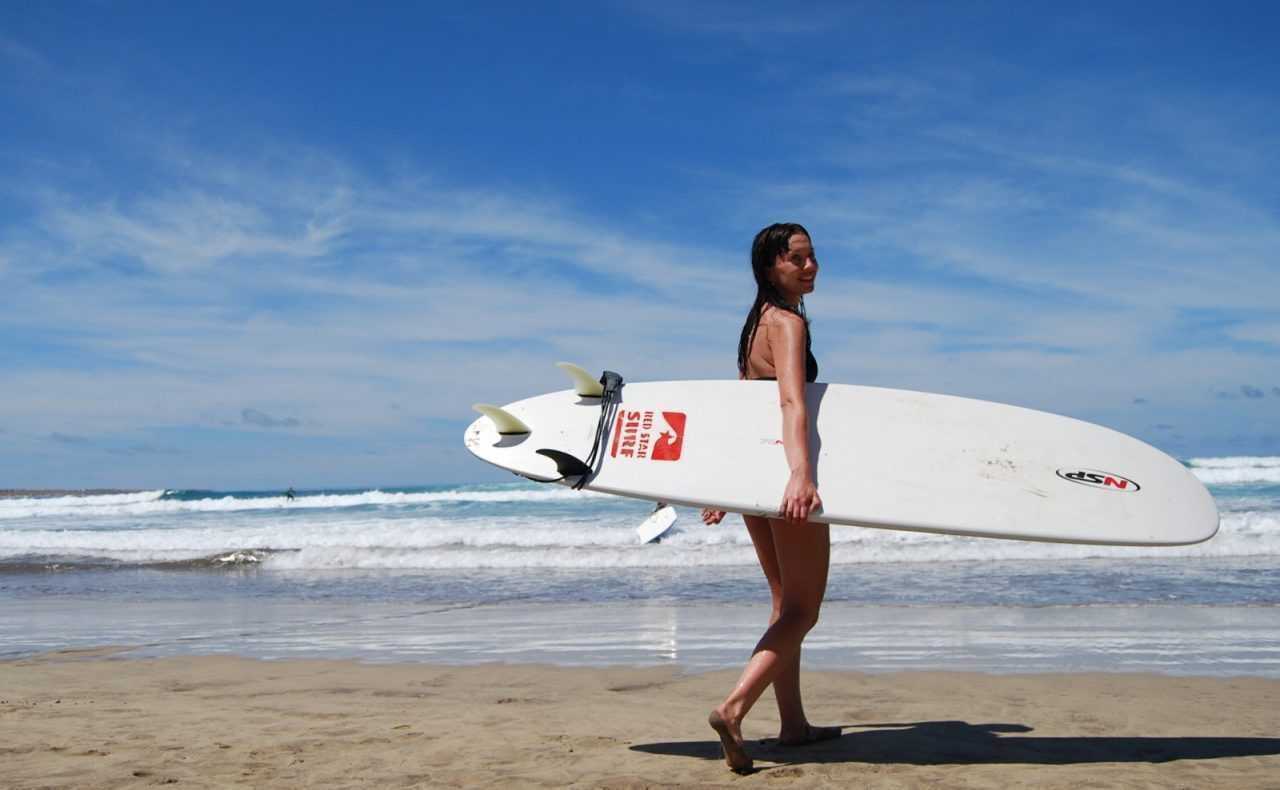
No sport is all upside. Sunburn is the most common injury at a surf school, by a distance, and it is entirely avoidable. Tight, sore shoulders in the first days are normal; a genuine shoulder strain from paddling with bad technique is not, and it is why a lesson is worth more than a rental in week one. Long-term surfers in cold water get exostosis — “surfer’s ear” — which ear plugs prevent; in Lanzarote’s 18–23 °C water the risk is low but not zero if you surf a lot in winter. Fins and other people’s boards cause the occasional cut or bruise, which is one more argument for a soft-top and a sandy beach. And the ocean is the ocean: currents, size and tides are things you learn to read, and until you can, you surf with someone who does.
How much surfing does it take?
More than one session and less than you think. A single lesson is a great morning; the physical changes — shoulders, balance, sleep — show up between day three and day five, which is why a surf camp week with a session every morning is the format that actually changes how people feel. Pair the morning surf with the afternoon yoga class on the terrace and you cover the two things surfing itself does not: stretching what paddling tightens, and slowing down what the ocean has just wound up. After that, the honest prescription is two or three sessions a week for as long as you can arrange your life around it.
Health and surfing — the questions we get
Is surfing a good workout?
Yes. A two-hour session is a long, low-intensity endurance effort (paddling) with repeated explosive bursts (pop-ups, sprint paddles) and constant balance work. It trains shoulders, back, core, legs and cardiovascular fitness at the same time, at roughly 300–500 kcal an hour for most adults.
Is surfing good for mental health?
Time spent in and around the ocean is consistently linked with lower stress and better mood — researchers call it blue space, and surf therapy programmes exist in several countries. Surfing also demands full attention, which works as an enforced break from screens and worries. It is not a treatment for anything, but most people leave a week of surfing calmer than they arrived.
Do I need to be fit to start surfing?
No. Beginner lessons happen in waist-deep whitewater on big soft boards, and the instructor puts you in position, so you need only to be able to swim and be comfortable in the sea. Some shoulder and core strength beforehand makes the first days more fun, but it is not a requirement.
What are the risks of surfing?
At beginner level: sunburn (very common, fully avoidable), sore shoulders in the first days, and the occasional bruise from a board. Serious injuries are rare on a sandy beach break with soft boards. Longer-term, cold-water surfers should wear ear plugs to prevent surfer’s ear; in Lanzarote’s warm water the risk is low.


