Updated
Lanzarote has waves on every coast, but only a handful of beaches are the kind where you can learn: sand under your feet, a gentle slope, whitewater that rolls for a long way and nothing sharp to land on. After fifteen years of teaching here, these are the five we would send a beginner to — in the order we would actually send them — with the tide, wind and season notes we use ourselves when we decide where the morning lesson goes.
What makes a beach good for beginners
Not the size of the waves. A beginner beach needs four things: a sandy bottom, so falling costs nothing; a gentle gradient, so the waves break slowly and reform into long whitewater instead of dumping on the shore; some protection from the wind, so the surface stays clean; and room, so you are not learning inside somebody else’s line-up. On Lanzarote that combination exists on the north coast around Famara and on a few small bays on the east coast that wake up when Famara is too big or too windy. Everything else on the island — La Santa, El Quemao, the reefs of the north shore — is for later.
| Beach | Bottom | Best for | Works when | Drive from Famara |
|---|---|---|---|---|
| Famara | sand, 6 km | every level, every day | any swell from the NW, all year | — |
| Orzola | sand + some rock | small groups, big-swell days | Famara is too big; N/NE swell | 40 min |
| Arrieta | sand, steep | experienced surfers; beginners only on rare small days | small E/NE swell, light wind | 25 min |
| Jameos del Agua | sand + reef | longboards, small clean days | E/NE swell, mid to high tide | 30 min |
| Las Cucharas | sand + rock, shallow | hotel guests in Costa Teguise | E swell, high tide | 30 min |
1. Playa de Famara — the beginner beach of the Canaries
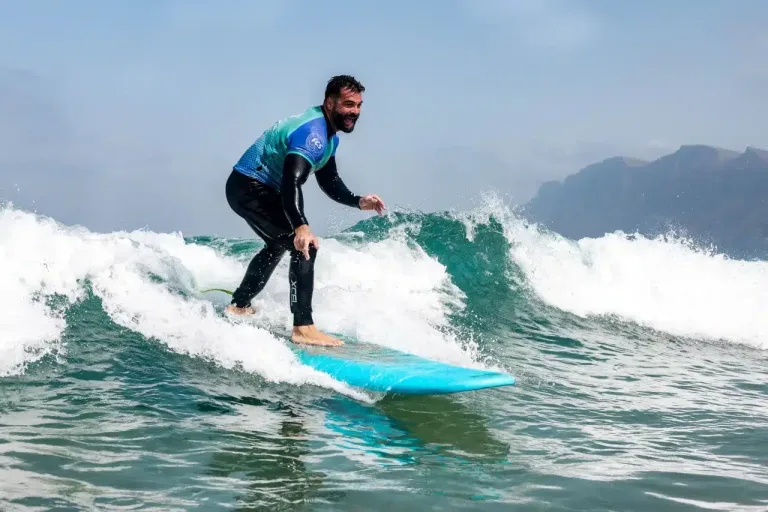
Six kilometres of sand under a 600-metre cliff, facing straight into the North Atlantic. Famara picks up every northwest swell that reaches the island, which means it has waves on days when the rest of Europe is flat, and its slope is so gentle that even a two-metre swell turns into long, rolling whitewater by the time it reaches waist depth. That is why nearly every surf school on Lanzarote is based here, including ours.

What makes it work for learning is the length. On a small day the lesson goes to the peaks in front of the village; on a big day it walks two hundred metres along the beach to a corner where the sandbanks slow the wave down, or to the whitewater inside. There is always a place on Famara that is the right size for a first lesson — the instructor’s job is finding it. The beach works on every tide, with mid tide usually the friendliest, and the wind is lightest in the morning before the afternoon breeze picks up. Check the live Famara webcam to see what a normal morning looks like, and our beginner surf lessons page for how a first day here is structured.
2. Playa de Orzola — for the days when Famara is too big
Orzola is the small fishing village at the very north tip of the island, where the ferry leaves for La Graciosa. The beach next to the village is a compact bay of white sand and black rock that catches north and northeast swell and hides from the big west-northwest energy that closes out Famara in the middle of winter. On a day when Famara is three metres and unrideable for a beginner, Orzola can be chest-high and organised.

It is not a first-ever-lesson beach: there is rock at the edges and the current pulls along the bay on a dropping tide, so you want to be there with someone who knows it, at mid to high tide, in a small group. But as a second-week beach, or as the plan B that saves a big-swell day, it is the best on the island. The drive from Famara along the north coast is forty minutes and one of the prettiest on Lanzarote.
3. Arrieta — a shorebreak with the occasional beginner day
Arrieta is a village on the north-east coast with a town beach, Playa de la Garita, that faces east. When a swell reaches it, it mostly breaks as a strong, fast shorebreak close to the sand — great fun for bodyboarders and experienced surfers, but on most of the days it works it is not a wave for beginners. Now and then a small, clean east or north-east swell with light wind gives it a few gentle days, and then it can be a nice change from Famara. Think of it as the exception rather than the rule: a beach we go to when the forecast lines up and the instructor is happy with it, not one to plan a first surf week around.

4. Jameos del Agua — the longboard beach
A few minutes south of Arrieta, below the César Manrique caves of the same name, there is a beach that the local schools from Costa Teguise use when the east coast is working. The wave here is a slow, long peeler over a mix of sand and flat reef, perfect for a longboard or a big soft-top, and it holds its shape when the north coast is blown out. It needs an easterly or northeasterly swell, which arrives with the trade winds in summer or with the occasional east storm in winter, and it wants mid to high tide — at low tide the reef shows and this stops being a beginner spot. When it is on, it is one of the most fun waves on the island to learn to turn on.

5. Las Cucharas — Costa Teguise
Las Cucharas is the main beach of Costa Teguise, better known for kitesurfing and windsurfing, because the trade wind blows across it every afternoon. For surfing it works in the mornings on an east swell, at high tide, when a soft wave breaks over a shallow mix of sand and rock. It is not the beach we would pick if you can get to Famara — it is smaller, shallower and windier — but if you are staying in Costa Teguise and want to try surfing without a drive, this is the wave under your hotel window, and the local schools there know exactly which hour of the tide to use.

Which beach on which day
| Conditions | Go to |
|---|---|
| Normal day, any season (NW swell 1–2 m) | Famara — pick the peak by size |
| Big winter swell (Famara 3 m+) | Orzola, or the sheltered inside at Famara |
| Strong wind on the north coast (summer afternoons) | Jameos del Agua, in the morning |
| Very small swell everywhere | Famara at low tide — the sandbanks make something out of nothing |
| Staying in Costa Teguise, no car | Las Cucharas at high tide |
If you only remember one thing: Famara first, and the east coast when Famara is too big or too windy. A surf school does exactly this calculation every morning at eight — it is the main reason to take a lesson in the first days rather than guess. Our Lanzarote surf guide goes through the whole island spot by spot, including the reefs to leave for later.
Where not to learn
La Santa, El Quemao, San Juan and the other reefs of the north shore are world-class waves that break over lava at low tide. They are what Lanzarote is famous for in surf magazines, and they are not beginner beaches under any conditions. The same goes for the far west end of Famara at high tide in a big swell, where the beach narrows against the cliff. None of this is dangerous if you know where you are — it is simply where the island stops being a beginner’s island.
What you need for a first session
A soft-top board of 8 feet or more, a 3/2 wetsuit in winter or a shorty in summer, and someone to show you the take-off. All of it is included in a lesson, and all of it is available from the rental shop if you already know what you are doing. Read how to take off on a surfboard before you come and the first lesson goes faster; and if you are choosing when to travel, winter is the best season for exactly these beaches.
Beginner surf beaches — the questions we get
What is the best beach in Lanzarote to learn to surf?
Playa de Famara. It is a six-kilometre sandy beach break with a gentle slope that works on any northwest swell all year, so there is always a corner the right size for a first lesson. Almost every surf school on the island is based there.
Can you surf on Lanzarote as a complete beginner?
Yes — Famara is one of the easiest places in Europe to learn, with waves every day and 18–23 °C water all year. A two-hour lesson is enough for most people to stand up in the whitewater on day one.
Is the east coast of Lanzarote good for beginners?
On the right day, yes. Jameos del Agua and Las Cucharas need an east or northeast swell and mid to high tide; they are small and sheltered when the north coast is too big or windy, and flat on a normal Famara day.
What is the best time of year to learn to surf in Lanzarote?
Any month works. Autumn and spring have the best balance of warm water, regular waves and light wind; winter has the most consistent swell and empty beaches; summer is smaller and windier in the afternoon, so lessons run in the morning.