
Updated
Europe has hundreds of surf schools, but the place you choose for your first week decides more than the school does: how warm the water is, how gentle the waves are and whether there are any at all when you arrive. We teach in Famara, on Lanzarote, and we will argue for it — but we also surf elsewhere, and the honest answer depends on when you can travel. Here are four very different places to learn to surf in Europe, compared side by side.
What makes a good place to learn
For a beginner, three things matter far more than the reputation of a spot. First, a sandy beach break with long, gentle whitewater — reefs and rocky points come later. Second, water warm enough that you can stay in for two hours and still enjoy it; cold water is not dangerous with the right wetsuit, but it shortens sessions and slows progress. Third, consistency: a week of lessons needs waves on most days, not a perfect swell once a month. After that come the school (certified instructors, small groups, the right boards), how busy the lineup is, and what there is to do when you are not in the water.
Four destinations side by side
The figures are typical ranges, not promises — the ocean has its own opinion. Use them to match a destination to the time of year you can travel.
| Famara (Lanzarote) | Unstad (Norway) | Berria (Cantabria) | Razo (Galicia) | |
|---|---|---|---|---|
| Best season to learn | all year, best Oct–May | summer | June–September | June–October |
| Water temperature | 18–23 °C | 4–14 °C | 12–22 °C | 13–20 °C |
| Wetsuit | 3/2, 4/3 in mid-winter | 5/4 or 6/5 + hood, boots, gloves | 3/2 in summer, 4/3–5/4 in winter | 4/3 most of the year |
| Beginner waves | sandbanks, whitewater on any tide | bay, works on smaller days | long beach, easy in summer | huge beach, always a peak |
| Daylight in winter | about 10.5 hours | almost none | about 9 hours | about 9 hours |
| Crowds | busy at weekends, space on weekdays | few surfers | busy in August | quiet outside summer |
Famara, Lanzarote (Canary Islands, Spain)
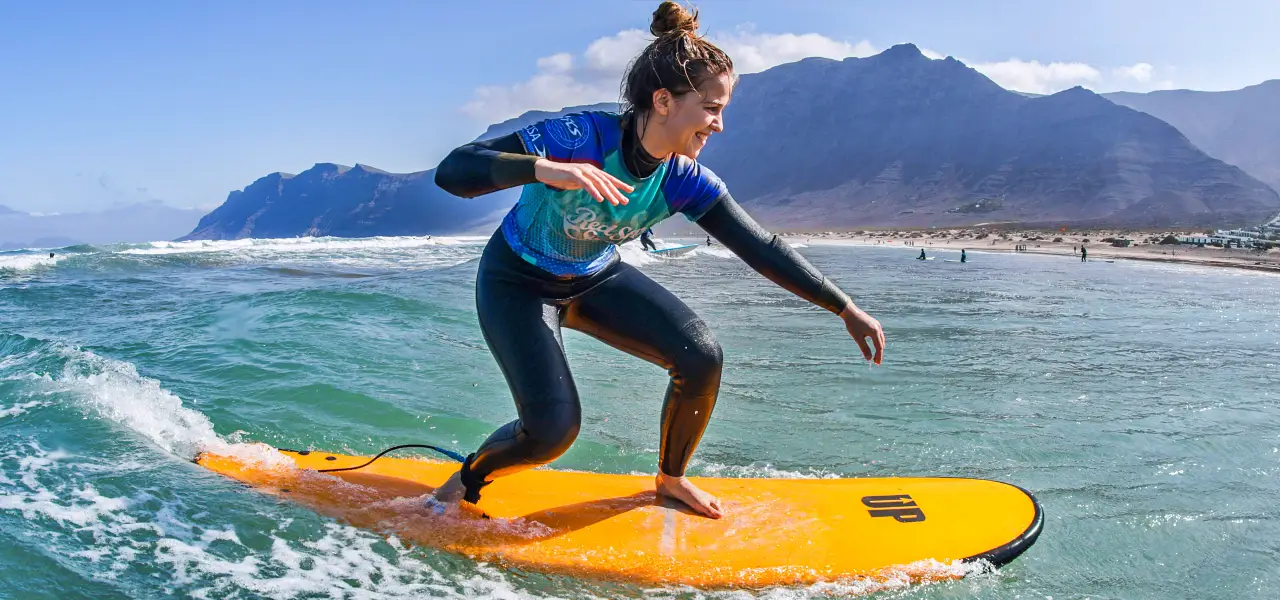
Famara is a six-kilometre sandy beach under the cliffs of the Chinijo natural park, facing the North Atlantic. It picks up swell all year, the sandbanks give easy whitewater on both low and high tide, and the water stays between 18 and 23 °C — which is why it is one of the very few places in Europe where learning to surf in January feels normal. The village, Caleta de Famara, is small and surf-first: no big hotels, sandy streets, the beach a few minutes’ walk away.

The catch is wind. From late spring to September the trade winds blow most afternoons, which is why lessons run in the morning — and why Famara is also a kite spot in summer. If you want the full picture, we wrote five reasons Lanzarote works so well for beginners, a surf spot guide to Famara and a comparison of the best beaches for beginners on the island.
Unstad, Lofoten (Norway)
Unstad sits inside the Arctic Circle, in a bay ringed by mountains, and it is the most spectacular place on this list to catch a wave. It is also the most demanding: the water stays roughly between 4 and 14 °C all year, so you surf in a thick wetsuit with boots, gloves and a hood. In winter there are only a few hours of daylight; in summer the sun never sets and you can surf at midnight. The surf culture is small, friendly and unlike anywhere else. For a first week it is an adventure more than a surf course — magical if you love cold places, hard work if you just want to learn to stand up.

Playa de Berria, Cantabria (northern Spain)
Berria, next to Santoña, is a long, exposed beach break that catches plenty of swell and breaks left and right along the sand, with tide rarely a problem. In summer the waves are usually small and friendly, which makes it a very good place to start; in winter the swell gets big and the water cold, and it becomes a spot for confident surfers. One school we like there is Watsay Surf School, which runs summer surf camps with plenty of activities on land as well — a good option for teenagers and families.
Playa de Razo, Galicia (northern Spain)
Galicia has been hiding from the crowds for years while France and Portugal filled up. Razo, on the Costa da Morte, is a huge open beach break that pulls in swell even when other spots are flat, so there is almost always a peak somewhere. From the lineup you look back at one of the wildest coastlines in Spain. Facilities are good, accommodation is easy outside July and August, and the water — 13 to 20 °C — means a proper 4/3 for most of the year. It is a great summer and early-autumn choice for people who want space in the water.

Our honest advice: pick the season first
If you can travel in July or August, all four of these work, and northern Spain is hard to beat for value and atmosphere. From October to May, the picture changes: the north of Spain and Norway get cold, dark and big, and the Canaries become the obvious answer — warm water, daylight and beginner-sized waves on the inside of the sandbanks. That is when most of our students come, and it is why we think winter is the best season to learn here.
If Famara fits your dates, you can start with beginner surf lessons (half-day from €50, full day with hotel pick-up and video analysis from €70) or stay in the village on a surf camp package with lessons and a private room in our surf house from €229 for three nights. Read more about why Famara is one of Europe’s best surf destinations before you decide.
Learning to surf in Europe — FAQ
Where is the warmest place to learn to surf in Europe?
The Canary Islands. In Famara on Lanzarote the water stays between about 18 and 23 °C all year and the air is mild even in January, so you can learn to surf in winter with a normal wetsuit.
When is the best time to learn to surf in Europe?
It depends on the place. Northern Spain, France and Portugal are easiest for beginners from June to September, when waves are smaller and water warmer. From October to May the Canary Islands are the better choice.
Can I learn to surf in a week?
In a week of daily lessons most people go from their first pop-up to riding whitewater waves on their own and starting to angle along green waves. Five days in a row is the format where progress becomes obvious.
Do I need to be fit to learn to surf?
No particular fitness is needed, but you should be able to swim 50 metres without help. A few weeks of shoulder and core work beforehand makes the first days much more comfortable.


