Updated
There is a moment every evening in Lanzarote when the wind drops, the light turns gold and the whole island seems to stop for ten minutes. Where you stand for those ten minutes matters. Some spots give you the sun sinking straight into the Atlantic, others a volcano glowing red, others fishing boats on a still lagoon. Here are the seven places we send our guests to — plus the one question everyone asks first: what time does the sun actually set?
What time is sunset in Lanzarote?
Lanzarote runs on Western European Time (UTC+0 in winter, UTC+1 in summer), one hour behind mainland Spain. Sunset moves by almost three hours across the year, so check the month before you plan an evening.
| Month | Sunset (approx.) | Month | Sunset (approx.) |
|---|---|---|---|
| January | 18:15 | July | 20:55 |
| February | 18:45 | August | 20:35 |
| March | 19:00 (20:10 after clocks change) | September | 20:00 |
| April | 20:20 | October | 19:25 (18:15 after clocks change) |
| May | 20:40 | November | 18:00 |
| June | 20:55 | December | 18:00 |
Times are for Famara, mid-month, and the same to within a couple of minutes across the island. The best colour usually comes 15–30 minutes after the sun has gone, so don’t pack up the moment it disappears. Two things to plan around: the trade winds, which blow hardest in the afternoon from June to September and make any exposed cliff-top a cold place to sit, and the calima, the Saharan dust haze that turns the sky milky but gives some of the deepest red sunsets of the year.
1. Famara Beach — sunset over the Atlantic
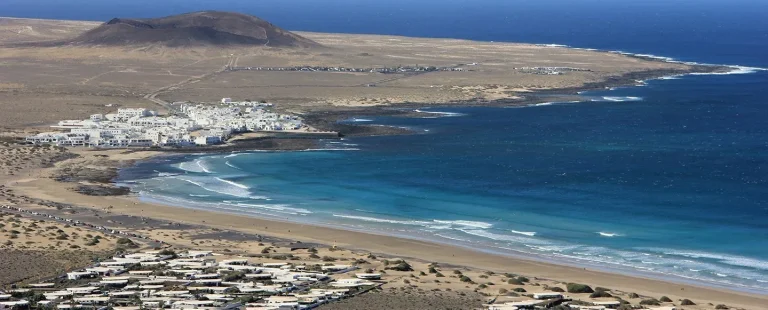
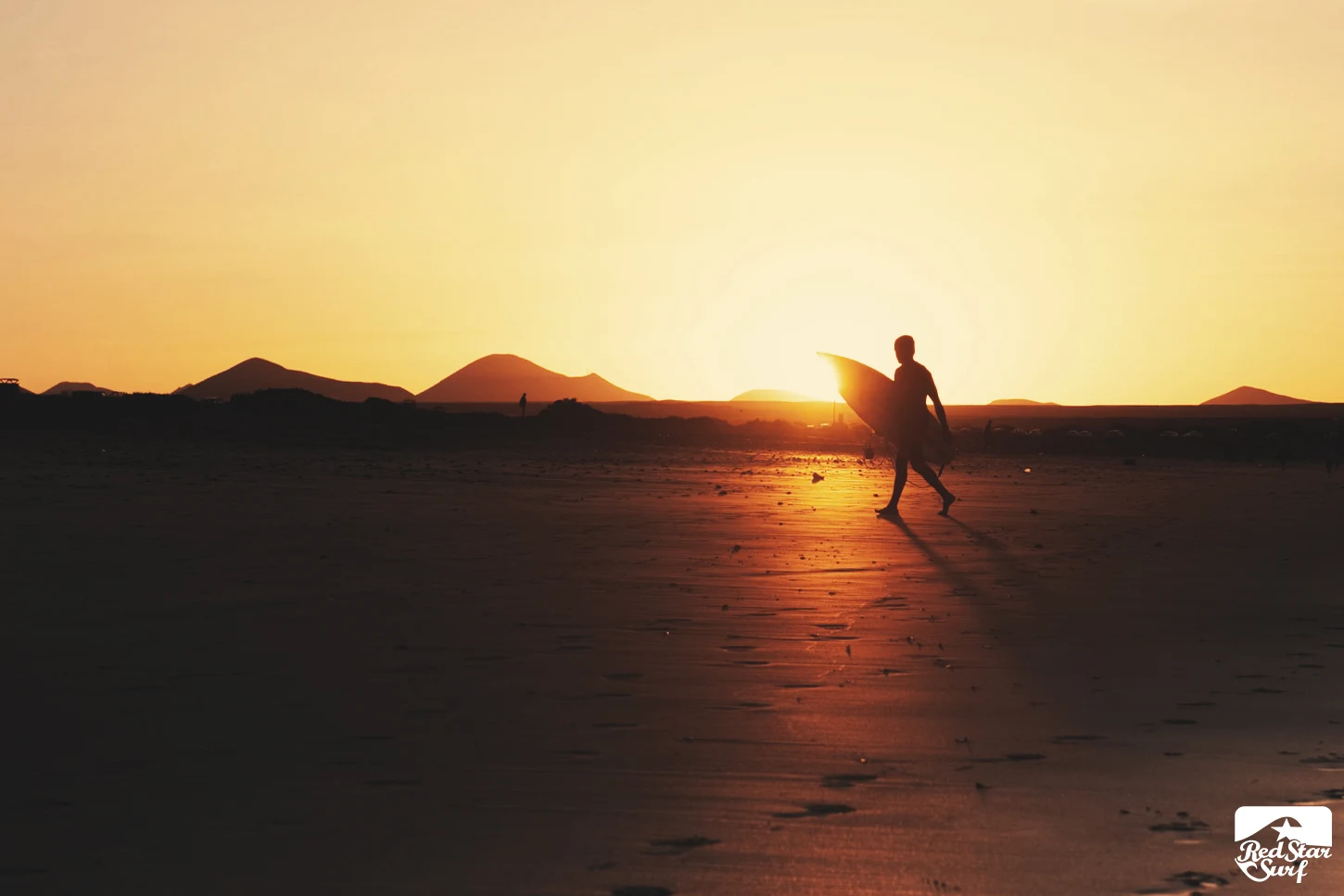
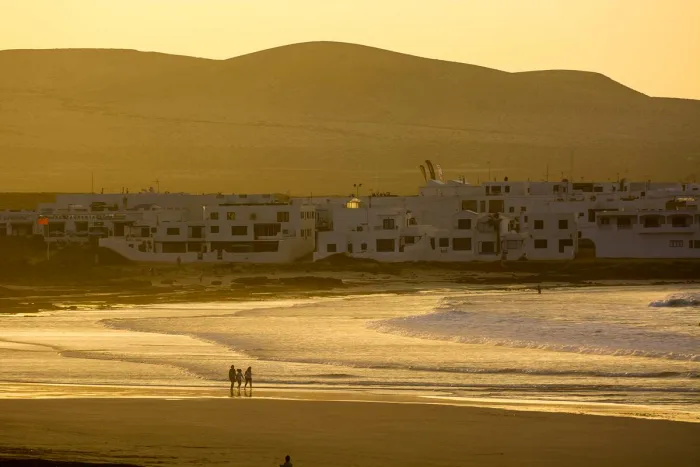
Our home beach, and honestly the reason this article exists. Playa de Famara is a six-kilometre stretch of sand facing northwest, backed by the 600-metre wall of the Risco de Famara cliffs. In the evening the sun drops straight into the ocean, the wet sand at low tide turns into a mirror, and the cliffs behind you go from brown to orange to purple in the space of twenty minutes. On a clear day you can see La Graciosa and the Chinijo islands to the north.
Walk out along the beach away from the village and you will usually have a whole stretch of sand to yourself. The last surfers of the day are still in the water at this hour, which makes for good photos. Check the Famara webcam before you drive up if you want to see what the sky is doing.
2. The Famara cliffs — Ermita de las Nieves viewpoint
If you want the same sunset from 600 metres higher, drive up to the Ermita de las Nieves, the small white chapel on the top of the Risco de Famara above Teguise. From the edge you look down on Famara beach, across to La Graciosa and along the whole north coast. It is the widest view on the island and it is free. Bring a jacket: it is always windier and several degrees colder up there than on the beach, and the road is narrow, so arrive with daylight to spare.
3. El Golfo and Los Hervideros — the volcanic west coast
The southwest coast between El Golfo and Playa Blanca is the most dramatic place on Lanzarote to watch the sun go into the sea. El Golfo itself is a fishing village of white houses with half a dozen fish restaurants right on the water; sit at a terrace table facing west and the sunset comes to you. A few minutes south, Los Hervideros is a stretch of black lava cliffs where the swell explodes through caves and blowholes. In the evening light, with a big Atlantic swell running, it is spectacular and a little frightening. There are walkways and viewpoints, so you don’t need to scramble over the rock.
4. Montaña Bermeja beach
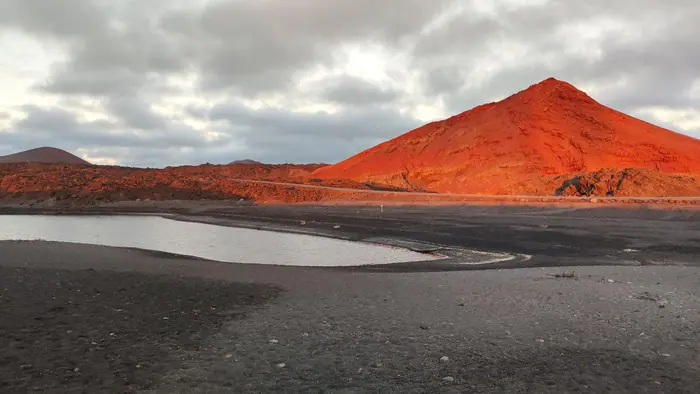
Just north of El Golfo, at the end of a dirt track, Playa de Montaña Bermeja is a small black-sand beach under a rust-red volcanic cone. The contrast — black sand, red mountain, white foam, orange sky — is the kind of thing photographers plan trips around. It is exposed, usually empty and not a swimming beach (the shore break is heavy), so come for the view. You need a car.
5. Caldera de los Cuervos — sunset inside a volcano
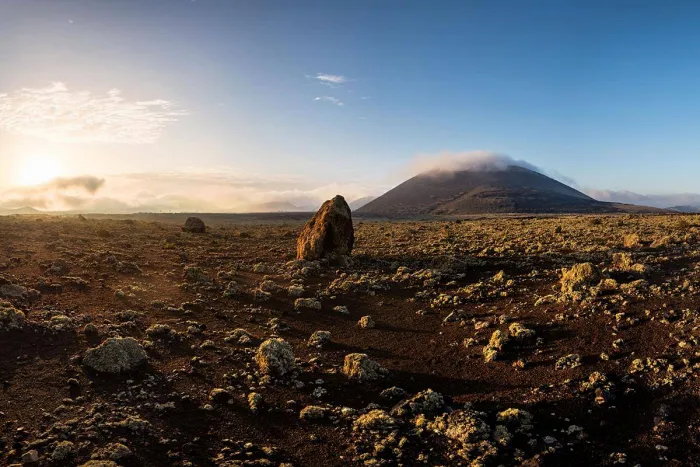
For something different, head inland to La Geria and walk the short, flat trail around and into the crater of the Volcán del Cuervo, the first volcano to erupt in the 1730s series that created Timanfaya. The walk takes about an hour at an easy pace. Time it so you are on the crater rim as the sun goes down and the whole lava field around you turns copper. This is one of the places where Lanzarote looks like another planet. Public transport doesn’t reach it, so it is a car trip — and you can combine it with the wine route through La Geria on the way back.
6. Charco de San Ginés, Arrecife
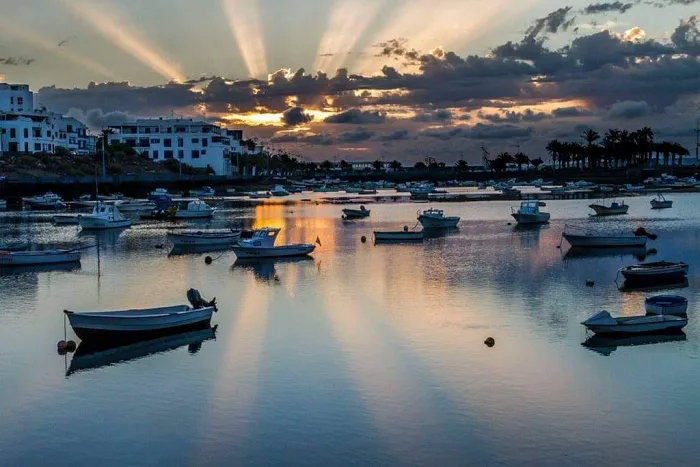
Back in the capital, the Charco de San Ginés is a saltwater lagoon that reaches right into the old town, with small fishing boats moored on it and houses and bars around the edge. At sunset the water goes still and the whole scene doubles in reflection. It is the most relaxed urban sunset on the island — order a drink on one of the terraces, stay for dinner. Easy to reach by bus from anywhere on Lanzarote if you don’t have a car.
7. El Reducto beach, Arrecife
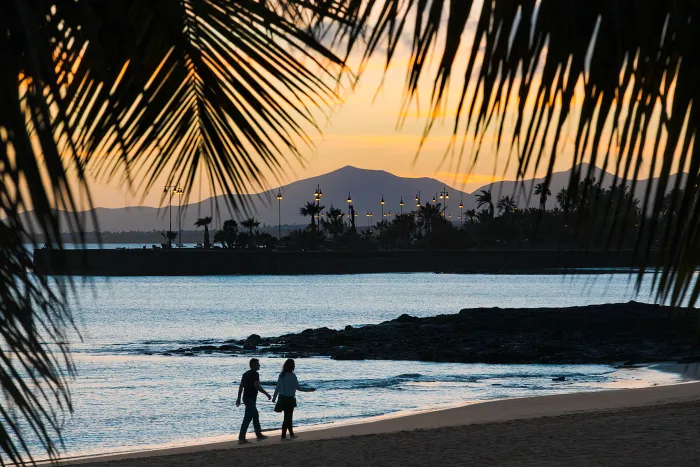
Also in Arrecife, a ten-minute walk from the Charco, Playa del Reducto is the city beach: calm, sandy, lined with a promenade. It is not the island’s most famous beach, but from the sand you watch the sun set behind the mountains inland with the sea in front of you, and it is the easiest sunset on this list to reach without a car.
A few practical tips
Face west. It sounds obvious, but the east-coast resorts — Puerto del Carmen, Costa Teguise, Playa Blanca’s main beach — see the sun set behind land, not the sea. For an ocean sunset you need the west or north coast: Famara, La Santa, El Golfo, Los Hervideros. Arrive at least half an hour early; the light changes fastest in the last twenty minutes before the sun goes. And in summer, bring a layer even if it was 28 degrees at lunch — the wind on the beach after sunset feels much cooler.
If you are staying in Caleta de Famara, the evening works itself out: surf or walk in the afternoon, sunset on the beach, then dinner in one of the village restaurants (we wrote a guide to what to eat in Lanzarote). For more ideas on filling the rest of the day, see our things to do in Lanzarote and the Visit Lanzarote guide.
Sunset questions we get asked
What time does the sun set in Lanzarote in summer?
Between roughly 20:35 and 20:55 from May to August, with the latest sunsets in late June. Lanzarote is on UTC+1 in summer, one hour behind mainland Spain.
What time is sunset in Lanzarote in winter?
Around 18:00 in December and January, 18:15–18:45 in February, and a little after 18:00 in November once the clocks go back.
Where is the best sunset in Lanzarote?
For a sunset over the ocean, Famara beach and the El Golfo / Los Hervideros coast are the two classics. For a volcanic backdrop, the Cuervo crater or Montaña Bermeja. For a sunset with a drink in hand and no car, the Charco de San Ginés in Arrecife.
Can you watch the sunset from Famara without a car?
Yes. Bus line 31 links Arrecife with Caleta de Famara several times a day, though the last return is early in the evening — check the schedule. Most people staying in Famara simply walk to the beach from the village.